

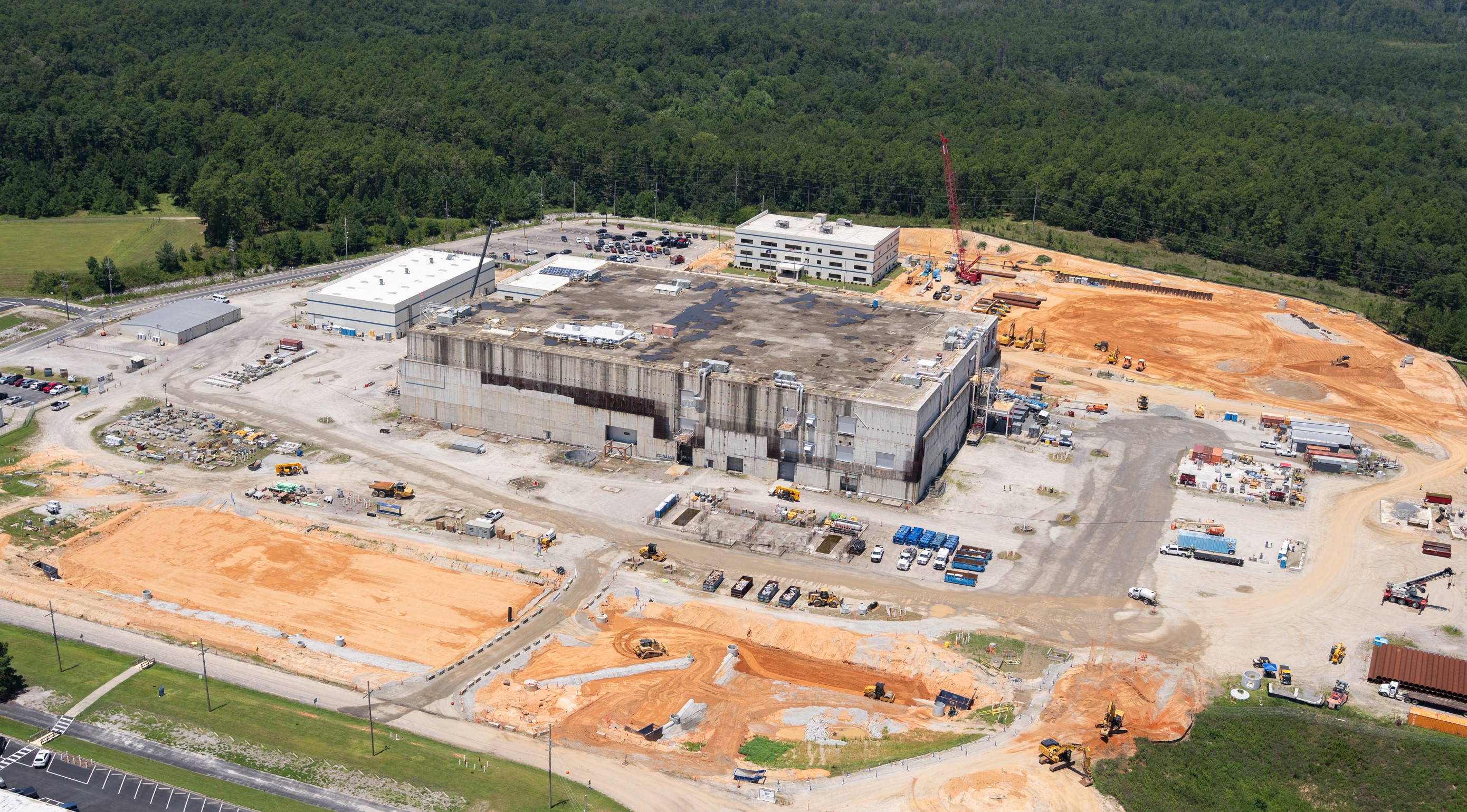
AIKEN, S.C. – The Savannah River Site (SRS) is opening new early construction work fronts to accelerate building the Savannah River Plutonium Processing Facility (SRPPF) and re-establish the nation’s capability to produce plutonium pits in support of sustainable nuclear deterrence.
“It’s amazing to see the scale and urgency at which dirt is moving around the SRPPF worksite with the early site preparation scopes in progress,” said Jeff Griffin, President and Chief Executive Officer, Savannah River Nuclear Solutions (SRNS). “The construction work fronts for this project are dynamic and will move throughout the project site as different tasks are completed and new ones begin. SRNS is working together with our partners to accelerate this important infrastructure project for the National Nuclear Security Administration (NNSA). Time is critical for this mission of national importance, and every day matters as we work to deliver SRPPF project completion by the early 2030s.”
SRNS, the management and operations contractor for the site, is collaborating with the NNSA and Construction Management subcontractor Fluor Federal Services to construct SRPPF, which will manufacture the majority of plutonium pits for the nation once operational. A plutonium pit is a critical component of every nuclear weapon.
The plutonium pit production mission is an essential part of the NNSA’s long-term strategy for nuclear stockpile sustainment. NNSA is revitalizing and modernizing its infrastructure across the Nuclear Security Enterprise, and re-establishing the country’s pit production capability is a national priority.
The SRPPF project involves repurposing an unfinished facility at SRS with more than 400,000 square feet of available Hazard Category-2 space. This allows the NNSA to make use of an existing, seismically-qualified structure to meet pit production requirements. The project also involves construction on more than 20 additional support facilities as well as building temporary infrastructure to support the incoming construction workforce.
“The SRPPF Project Execution organization is opening up additional work fronts not already in progress prior to starting Critical Decision (CD)-2/3 construction,” said Mike Basham, SRNS Senior Vice President and SRPPF Project Director. “NNSA approval of CD-2/3 will establish a baseline for the project and provide authorization to proceed with full construction. In preparation for CD-2/3 approval, we’re optimizing our construction approach and opening up new work fronts to accelerate the project.”
Early site preparation activities include subprojects inside and outside of the SRPPF Main Process Building, such as interior and exterior building modifications, Special Facility Equipment procurement, and the installation of underground water system utilities and infrastructure.
“We’re making significant, measurable progress in F Area ahead of the main SRPPF construction buildout,” said Bob Smith, Fluor Senior Vice President and Interim SRPPF Project Director. “It’s nice to see visible changes both inside the facility and out. Fluor is proud to work with SRNS and our sub-tier contractors as we execute these early work scopes.”
During the life of the SRPPF project, more than 4,000 craft and staff employees are expected to support construction. To support workforce needs, SRNS signed a Project Labor Agreement with the Augusta Building and Construction Trades Council. Once constructed and operational, SRPPF is expected to require approximately 2,100 employees.
Under federal law and to meet national security requirements, NNSA must be able to produce no fewer than 80 pits per year to maintain and replenish the nuclear stockpile. The Nuclear Weapons Council endorsed NNSA’s approach for supplying plutonium pits to meet stockpile requirements: a two-site strategy with SRS producing no fewer than 50 pits per year and Los Alamos National Laboratory in New Mexico producing no fewer than 30 pits per year. This approach will provide an effective, responsive and resilient nuclear weapons infrastructure with the flexibility to adapt to shifting requirements and counter future threats.
Established by Congress in 2000, NNSA is a semi-autonomous agency within the U.S. Department of Energy responsible for enhancing national security through the military application of nuclear science. NNSA maintains and enhances the safety, security, and effectiveness of the U.S. nuclear weapons stockpile; works to reduce the global danger from weapons of mass destruction; provides the U.S. Navy with safe and militarily effective nuclear propulsion; and responds to nuclear and radiological emergencies in the U.S. and abroad.
Savannah River Nuclear Solutions, a Fluor and HII partnership company, is responsible for the management and operations of the Department of Energy’s Savannah River Site, located near Aiken, South Carolina.
SRNS-2025-1676