

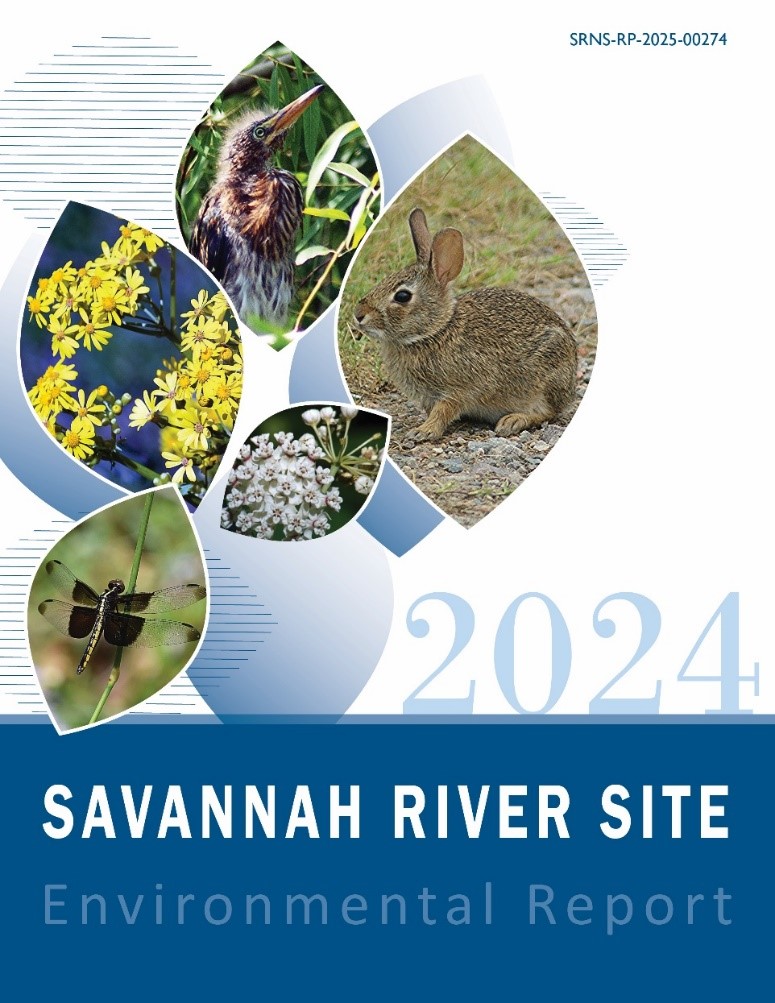
AIKEN, S.C. – Each year the Savannah River Site (SRS), along with other U.S. Department of Energy (DOE) sites, are responsible for the development and design of an Annual Site Environmental Report (ASER) appropriate to site-specific considerations and in compliance with DOE reporting requirements.
This report is published to provide the public and SRS stakeholders with comprehensive information on the Site’s environmental conditions for the previous calendar year. The ASER is a key component of DOE’s commitment to openness and public understanding of their operations. Additionally, the ASER serves to keep the public informed of environmental conditions at DOE sites.
SRS has been tracking environmental conditions since the Site’s establishment in the early 1950s and has released an ASER annually since 1959. Over the last 75 years, the comprehensive SRS Environmental Monitoring Program has shown the following:
- The annual dose from SRS operations is less than one millirem. For context, the annual average dose per person in the U.S. from all natural and man-made sources is about 620 millirems.
- SRS protects, monitors, remediates and conserves groundwater at SRS.
- SRS employs innovative, cost-effective technologies to reduce the Site’s environmental footprint.
SRNS’ Environmental Compliance and Area Completion Projects (EC&ACP) team collects more than 10,000 monitoring and surveillance samples annually from air, water, soil, sediment, food products, freshwater fish, seafood, wildlife, plants and trees. These samples, collected on-site and from neighboring cities, towns and counties in Georgia and South Carolina, are analyzed by the Environmental Bioassay Laboratory at SRS, or at an off-site accredited laboratory. Reports are then compiled and reported by the Environmental Monitoring group.
According to SRNS Environmental Monitoring Program Manager Eric Doman, “A chief purpose of the ASER is to document the radiological and non-radiological condition of the Site environment, the effluents and emissions released from DOE operations and noteworthy trends regarding these releases and environmental conditions. The report also summarizes SRS’ environmental data; compliance with relevant DOE, federal and state regulations; and updates on its remediation and surveillance monitoring programs.”
In 2024, SRS continued to operate safely and accomplish its missions, all while upholding a strong record of environmental excellence. As in past years, the Site adhered to federal and state regulations aimed at protecting both the public and SRS employees.
“The ASER reflects more than just numbers and data—it is a demonstration of our longstanding commitment to continually improving our environment,” said NNSA Savannah River Field Office Manager Michael Mikolanis. “By sharing this report, we reaffirm our responsibility to both mission execution and environmental stewardship, and our dedication to keeping the community informed of our performance.”
This 269-page report is a year-long focus for the Environmental Monitoring team and serves as DOE’s primary document to educate the public on environmental programs, missions, accomplishments and community outreach efforts at the Site. The SRS ASER has been referenced for many years as a model across the DOE-Complex, and for the second consecutive year, SRS was the first site across the complex to publish the ASER on SRS’ external website for the public to view. Click here to view the 2024 ASER.